
|
| You might also like: | Contents - All About Butterflies | Today's featured page: Bulletin Boards in Classrooms |
| Our subscribers' grade-level estimate for this page: 1st - 2nd |
 Table of Contents |
Enchanted Learning ALL ABOUT BUTTERFLIES! |
Butterfly Calendar |
| What is a Butterfly? | Life Cycle | Butterfly Anatomy | Information Sheets | Glossary | Printables and Activities |
| Butterfly Glossary |
| A | B | C | D | E | F | G | H | I | J | K | L | M | N | O | P | Q | R | S | T | U | V | W | X-Z |
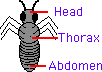 ABDOMEN The abdomen is the segmented tail area of an insect (including butterflies and moths). An insect's abdomen contains its heart, Malpighian tubules, reproductive organs, and most of the digestive system (foregut, hindgut and rectum). It is protected by an exoskeleton. The abdomen of butterflies and moths have eleven segments (the terminal 2 or 3 segments are fused together). |
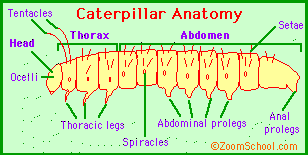 ABDOMINAL PROLEGS Abdominal prolegs are the peg-like legs on the abdomen (hind region) of a caterpillar. These legs have crochets (small hooks) on them. These legs disappear in the adult butterfly. |
AEROPYLE Aeropyles are microscopic holes that dot the surface of the egg. Aeropyles let oxygen into the egg. |
AMERICAN COPPER BUTTERFLY The American Copper Butterfly (Lycaena phlaeas) is an orange-red butterfly with a gray underside. The wing span is 7/8 to 1 3/8 inches (2.2 - 3.5 cm). The host plants are sheep sorrel and curled dock. The caterpillar is slug-like. Adults drink nectar from many flowers including the buttercup, butterflyweed, clover, yarrow, and ox-eye daisy. It lives in Europe and North America (from Nova Scotia to the southern USA). Classification: Family Lycaenidae, Genus Lycaena, Species phlaeas, |
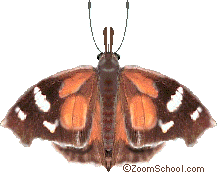 AMERICAN SNOUT BUTTERFLY The American Snout (Libytheana carinenta) is a butterfly that has long labial palps (mustache-like scaly mouthparts on either side of the proboscis) that look like a long snout. The butterfly has a 1 3/8 - 2 inch (3.5 - 5 cm) wingspan. The front pair of legs on the male (but not the female) are reduced in size. Eggs are laid in groups on the hackberry plant. The caterpillar eats hackberry (celtis); the adult sips nectar from the flowers of asters, dogbane, dogwood, goldenrod, sweet pepperbush, and more. Adult American Snout butterflies look like dead leaves. They sometimes go on long migrations. They are brush-footed butterflies (Family Nymphalidae). |
ANAL PROLEGS Anal prolegs are a pair of stumpy legs at the very end of a caterpillar's abdomen (hind region). These legs have crochets (small grasping hooks) on them. |
ANDROCONIA Androconia (also called scent scales) are modified wing scales on butterflies and moths that release pheronomes. Only males have these scent scales. The pheromones attract females of that species. |
ANGIOSPERM Angiosperms are flowering plants that produce seeds enclosed in fruit. They are the dominant type of plant today; there are over 250,000 species. Their flowers are used in reproduction. Angiosperms evolved 125 million years ago and became the dominant plants about 100 million years ago. Angiosperms are divided into monocots (like corn) and dicots (like beans). |
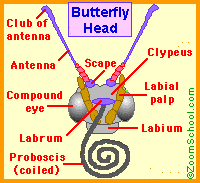 ANTENNAE Antennae (singular antenna) are sensory appendages attached to the head of some adult insects. Antennae are used for the sense of smell and balance. Butterflies have two segmented antennae with a small club at the end of each. Moths have antennae without the club. Larvae (caterpillars) have tiny sensory antennae. |
 ANTHOPHYTA Anthophyta are flowering plants, the largest group of plants (which includes the grasses). The flowers are used in reproduction. They evolved during the Cretaceous period. Butterflies and moths are important pollinators of these plants. |
APICAL Apical means towards or at the apex (the uppermost point or top). |
 APOSEMATIC COLORATION Aposematic coloration (or warning coloration) is the bright, attention-getting coloration that protects an organism from experienced predators (i.e., predators who have previously eaten a similar-looking animal and have gotten sick from it). Both poisonous organisms (like the Monarch butterfly) and its mimics (poisonous or not) are said to have aposematic coloration. |
ARMY An army is the term for a group of caterpillars. |
  ARTHROPODS Arthropods are a group of animals with exoskeletons made of chitin, segmented bodies and jointed limbs. Insects, arachnids, trilobites, crustaceans, and others are arthropods. |
  AUTOTROPH An autotroph (or producer) is an organism that makes its own food from light energy or chemical energy. Most green plants, many protists (one-celled organisms like slime molds) and most bacteria are autotrophs. Autotrophs are the base of the food chain. |
|
Butterfly Glossary |
|
|||||
| A | B | C | D | E | F | G | H | I | J | K | L | M | N | O | P | Q | R | S | T | U | V | W | X-Z |
Enchanted Learning®
Over 35,000 Web Pages
Sample Pages for Prospective Subscribers, or click below
|
Overview of Site What's New Enchanted Learning Home Monthly Activity Calendar Books to Print Site Index K-3 Crafts K-3 Themes Little Explorers Picture dictionary PreK/K Activities Rebus Rhymes Stories Writing Cloze Activities Essay Topics Newspaper Writing Activities Parts of Speech Fiction The Test of Time
|
Biology Animal Printouts Biology Label Printouts Biomes Birds Butterflies Dinosaurs Food Chain Human Anatomy Mammals Plants Rainforests Sharks Whales Physical Sciences: K-12 Astronomy The Earth Geology Hurricanes Landforms Oceans Tsunami Volcano |
Languages Dutch French German Italian Japanese (Romaji) Portuguese Spanish Swedish Geography/History Explorers Flags Geography Inventors US History Other Topics Art and Artists Calendars College Finder Crafts Graphic Organizers Label Me! Printouts Math Music Word Wheels |
Click to read our Privacy Policy
| Search the Enchanted Learning website for: |